Policy & regulation / News explained
Six peptides, not fourteen: checking the new compounding claims
What the October 2026 HHS announcement covers, why October 30 appears in posts, and why wider access is not FDA approval.
Reporting checked October 28, 2026. Social posts are celebrating a change in U.S. peptide access, but their wording blends several different events: an earlier promise about fourteen peptides, a new announcement covering six, and a Federal Register publication date. Keeping those separate makes the news more useful.
The takeaway: Current reporting identifies six peptides covered by HHS's temporary enforcement-discretion policy. That is not approval of fourteen drugs, proof of effectiveness, or permission for unrestricted retail sale.
Which six peptides are named?
NBC News and Reuters reporting on October 28 identify BPC-157, epitalon, KPV, MOTS-c, Semax and TB-500. The announcement concerns prescription compounding while regulators consider a formal change to the rules for bulk drug substances.
Enforcement discretion describes when an agency does not intend to take enforcement action under stated conditions. It is different from FDA approval of a finished medicine and different from a permanent addition to the Section 503A bulk-drug-substances list.
Where did the fourteen-peptide claim come from?
A reader-supplied screenshot dated February 27, 2026 attributes a broader fourteen-of-nineteen prediction to Robert F. Kennedy Jr.'s appearance on the Joe Rogan podcast. We have not independently verified the full recording or its context. A screenshot documenting a prediction is not an official list of substances now eligible for compounding.
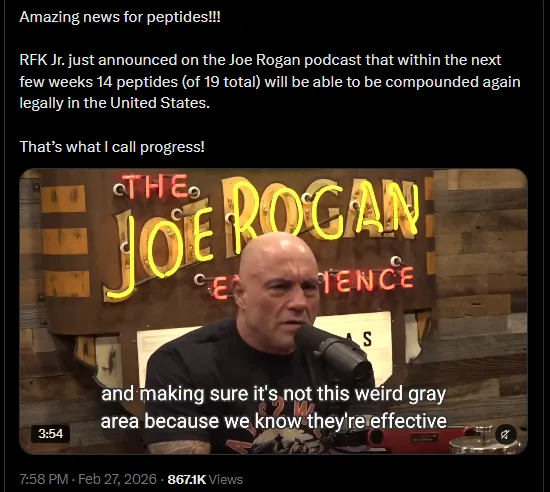 Reader-supplied social-media screenshot, shown for analysis. The embedded video is not independently verified here.
The six-peptide October announcement should be evaluated on its own terms. Neither the earlier prediction nor the screenshots establish that all fourteen substances have received the same regulatory treatment.
Does Friday, October 30 mean everything becomes legal that day?
The Federal Register public-inspection listing says the HHS notice is scheduled for publication Friday, October 30, 2026. As checked on October 28, that listing still labels the document unpublished.
That is a publication date, not by itself a universal start date for every pharmacy or every preparation. NBC News reports that qualifying pharmacies can offer the six substances immediately under the temporary policy. We could read the public-inspection listing but could not open its linked policy PDF during this review; readers should consult the final notice and their licensed clinician or pharmacist for the exact conditions and timing.
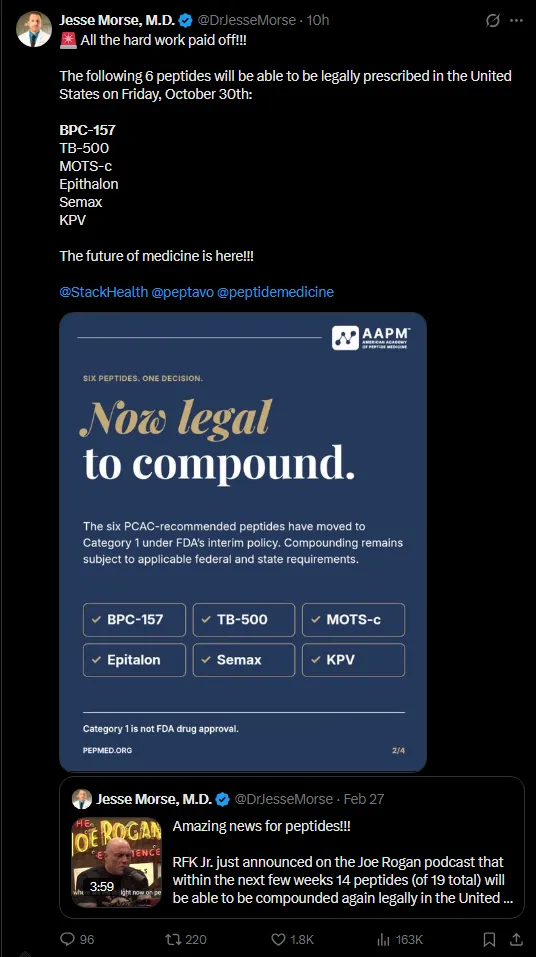 Post attributed to Jesse Morse, M.D., supplied by a reader. Its October 30 claim should be read alongside the official publication listing and current reporting.
What about Category 1 and 'now legal to compound'?
A reader-supplied post attributed to the American Academy of Peptide Medicine describes the six peptides moving to Category 1. That professional organization's statement is not itself the FDA's operative policy. The most important practical distinction is between conditional enforcement discretion, formal list inclusion and drug approval.
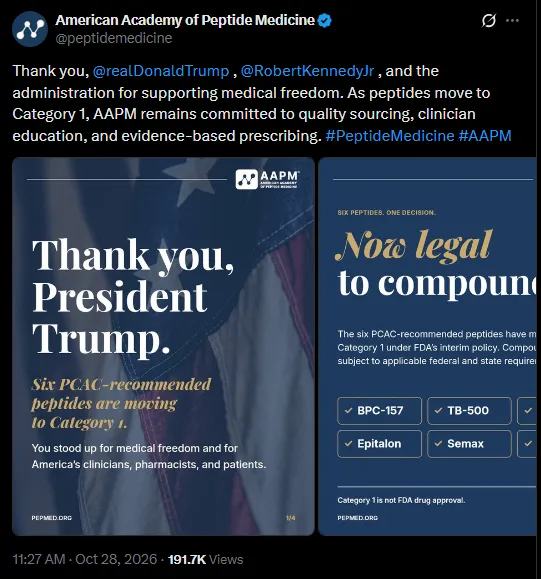 Reader-supplied advocacy statement. The artwork itself notes that Category 1 is not FDA drug approval.
According to NBC News, compounders must certify identity and purity and report side effects. Applicable prescription requirements and federal and state obligations still matter. A social graphic cannot determine whether a particular product, route, seller or prescription complies.
What does this mean for patients?
Broader access and stronger evidence are separate developments. NBC News reports that FDA scientists found insufficient evidence to establish these peptides' safety and effectiveness. A change in enforcement policy does not resolve that evidence gap.
- Ask a licensed clinician whether there is a medically justified reason to consider a compounded preparation.
- Ask the pharmacy about the current policy, ingredient identity, quality testing and adverse-event reporting.
- Do not interpret this announcement as authorization to inject research-use-only products or replace established treatment.
Where wellness strips fit—and where they do not
This policy is not an endorsement of Neuvéra products or oral-strip delivery. Evidence and regulatory status for one preparation cannot automatically be transferred to another format.
For product information rather than treatment recommendations, visit our Formula Library or strip directory. The directory provides onward links to Neuvéra, where products are sold and fulfilled. Strips Over Needles is an informational referral site; these links are separate from the regulatory reporting.
Sources and verification notes
- Federal Register: HHS public-inspection notice—listing checked October 28; scheduled publication October 30. Linked PDF could not be opened during this review.
- NBC News, October 28: temporary access, safeguards and evidence limitations.
- Reuters report republished by Investing.com, October 28.
- Reader-supplied social screenshots reproduced for commentary; original posts and the full podcast were not independently authenticated.
This is a dated news explainer, not medical or legal advice. Check the linked sources for later developments.