Research explained / News explained
BPC-157 for knee pain and oral delivery: what two cited studies show
A closer look at the small human knee-injection report and the rat ligament experiment behind viral BPC-157 claims—and why neither proves oral-strip benefits.
Evidence review checked October 28, 2026. Two social-media claims are drawing attention to BPC-157: that a human knee study showed a roughly 90% success rate, and that oral BPC-157 can repair ligaments throughout the body. Both posts cite real publications. Neither publication supports all of the claims attached to it.
The takeaway: A small human report found self-reported pain improvement after knee injections. A separate ligament study found improvements in rats, including with administration in drinking water. Neither establishes that commercial oral strips repair human knee injuries or replace surgery.
The human knee study: real patients, limited evidence
Edwin Lee and Blake Padgett's 2021 paper, Intra-Articular Injection of BPC 157 for Multiple Types of Knee Pain (PMID 34324435), was a retrospective review at a single Florida practice. It examined records from 2019–2020, with telephone follow-up rather than a randomized clinical trial.
The paper included 17 patients; 16 could be reached. The abstract reports:
- BPC-157 alone: 11 of 12 patients reported significant pain improvement, or 91.6%.
- BPC-157 plus thymosin-beta-4: 3 of 4 reported improvement, or 75%.
- Combined groups: 14 of 16 reported relief, or 87.5%.
Those distinctions matter. Calling the entire report a '90% success rate' obscures the different groups, and 'success' was self-reported pain improvement—not proof of structural repair.
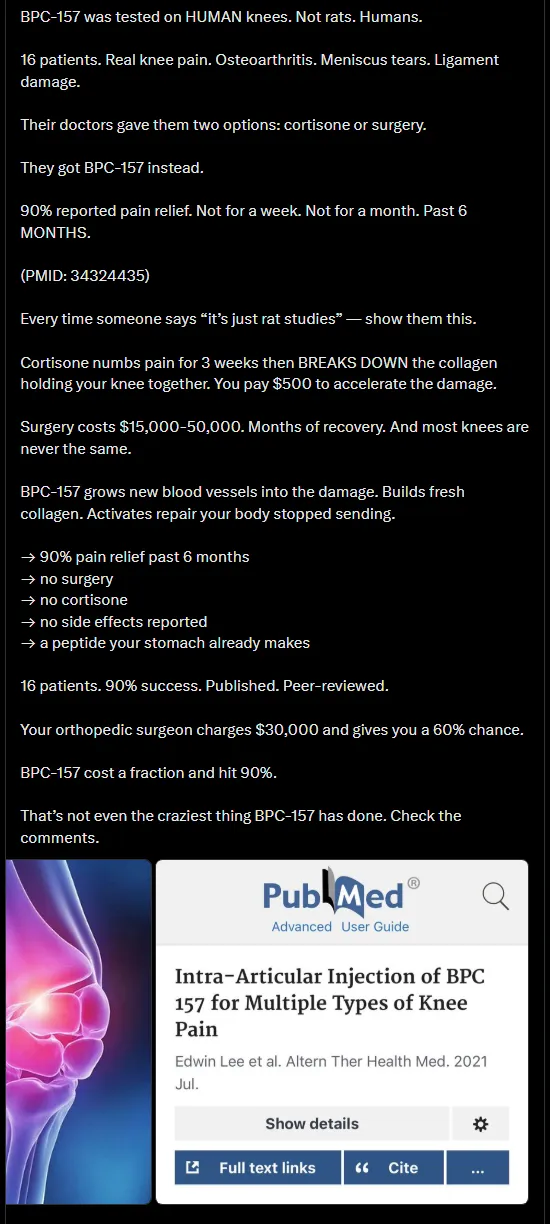 Reader-supplied post, reproduced for fact-checking. Its claims go beyond what the cited study can establish.
Did relief last beyond six months for everyone?
The abstract says follow-up varied and that most patients had received their injection six months to one year before the study. That does not establish that every responder experienced continuously sustained relief beyond six months.
Patients were asked about pain before injection, how long relief lasted and how much the injection helped. The authors explicitly state that no specific tools were used to measure function, quality of life, stiffness or activities of daily living.
Why this is not proof that BPC-157 beats surgery or cortisone
The report had no randomized comparator group. It therefore cannot establish that BPC-157 outperforms surgery, steroid injections, rehabilitation or placebo. A small uncontrolled series cannot separate a treatment effect from natural recovery, expectations, other care or differences in the patients selected.
The authors discuss possible tissue-repair benefits but also call for future studies with follow-up MRI scans. Reported pain relief is not evidence that cartilage, meniscus tears or ligaments were rebuilt in these patients.
The social post's surgery prices, surgical success percentages and sweeping claim that cortisone breaks down the knee are not established by this report. Different diagnoses and treatments require individual assessment; cross-treatment comparisons need appropriate comparative evidence.
Similarly, a small report cannot establish 'no side effects' or rule out uncommon or delayed harms. The abstract does not provide the kind of comprehensive safety assessment needed for that conclusion.
The oral ligament study was in rats
The second post cites PMID 20225319. The title states the species plainly: Pentadecapeptide BPC 157 (PL 14736) improves ligament healing in the rat, published in 2010 in the Journal of Orthopaedic Research.
Researchers surgically transected rats' medial collateral ligaments and evaluated healing over 90 days. The abstract describes intraperitoneal administration, topical application and oral administration through drinking water. It reports functional, biomechanical, macroscopic and histological improvements.
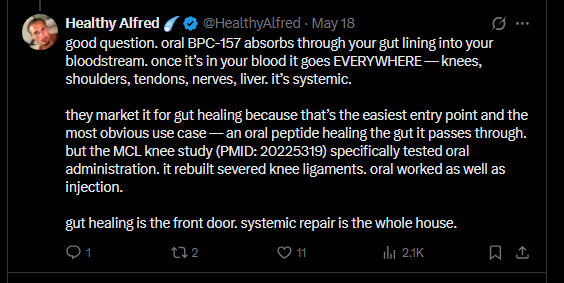 Reader-supplied post attributed to Healthy Alfred. The cited ligament experiment involved rats, not human oral-treatment outcomes.
This is a preclinical finding worth studying. It is not proof that oral BPC-157 has equivalent effectiveness to injection in humans. A claim of equivalence requires direct, appropriately designed comparative evidence; observing improvements with several routes in an animal experiment is not enough.
Does oral absorption prove whole-body repair?
No. Absorption, blood concentration, delivery to a tissue and meaningful clinical benefit are different questions. The rat study does not establish human oral bioavailability, an effective human treatment regimen, or clinical repair in the shoulders, nerves, liver or other organs claimed in the post.
It also did not test a Neuvéra strip. Swallowed administration in rat drinking water, injection into a human knee and an oral-strip formulation are different interventions. The findings cannot be transferred between them without formulation-specific human evidence.
Questions worth bringing to a clinician
- What is causing the knee pain, and what evidence-based options fit that diagnosis?
- Is the evidence from controlled human trials, an uncontrolled case series or animal experiments?
- Does the research test the exact preparation and delivery route being proposed?
- What is known—and still unknown—about safety and longer-term outcomes?
Do not delay assessment, stop prescribed treatment or use research-only peptides based on a viral post. Changes to compounding access do not by themselves establish clinical effectiveness.
Explore ingredients without confusing formats
Our Formula Library provides ingredient context. The strip directory provides product information and onward shopping links to Neuvéra, which sells and fulfills the products. Strips Over Needles is an informational referral site. Those links are not evidence that strips reproduce the injection or animal-study results described here.
Sources and review limits
- Lee and Padgett, 2021: Intra-Articular Injection of BPC 157 for Multiple Types of Knee Pain. PubMed abstract; 17 records, 16 telephone respondents.
- Cerovecki and colleagues, 2010: Pentadecapeptide BPC 157 (PL 14736) improves ligament healing in the rat. PubMed abstract; animal study.
- NBC News, October 28, 2026: peptide policy and outstanding safety/effectiveness concerns.
- Two reader-supplied social screenshots, examined as claims rather than independent evidence. Original posts were not independently authenticated.
This review is based on the cited study abstracts, not an independent reanalysis of patient records or a systematic review of all BPC-157 research. It is educational reporting, not medical advice.