Policy & Regulation / News explained
Retatrutide is a drug, not a biologic: what FDA’s decision means
FDA reaffirmed retatrutide’s drug classification in October. Here is what the 39-amino-acid dispute means—and why it does not authorize compounding or guarantee lower prices.
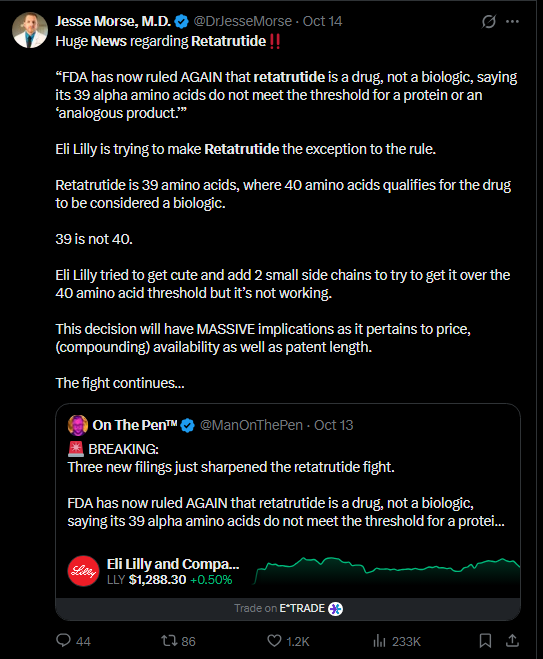
Reporting checked October 28, 2026. The featured image is a reader-supplied screenshot of an October 14 post attributed to Jesse Morse, M.D., on X. It is included as the claim being examined, not as an FDA announcement or an endorsement. The original post’s address was not supplied; our conclusions rely on the linked regulatory documents and reporting below.
The short version: FDA reaffirmed on October 2, 2026, that retatrutide is a drug, not a biological product. That classification could matter for future competition and regulatory exclusivity. It is not FDA approval, permission to compound retatrutide, a price announcement or a ruling that changes its patents.
What FDA actually decided
A social-media post circulating this month says FDA has again rejected Eli Lilly’s argument that retatrutide should be regulated as a biologic. The central claim is supported by FDA’s October 2 determination, filed in the litigation. The agency states that retatrutide is neither a “protein” nor an “analogous product” to a protein and therefore is not a biological product.
This is a decision about the regulatory category of an investigational medicine. It is separate from the review that would establish whether a medicine can be approved for a particular use. Calling retatrutide a drug does not mean it is an approved drug.
The amino-acid threshold: more than 40, not 40
The screenshot describes retatrutide as having 39 amino acids and suggests that 40 would qualify it as a biologic. That shorthand misses an important detail: the protein definition discussed in the case requires an alpha-amino-acid polymer with a specific, defined sequence that is greater than 40 amino acids. Exactly 40 does not cross that numerical threshold.
FDA describes retatrutide as having a chain of 39 alpha amino acids, with an attached side chain containing other chemical components. Lilly has argued for counting the molecule differently and has also argued that it is analogous to a protein. FDA does not accept that the side-chain components create a qualifying additional alpha-amino-acid chain. The dispute is about which structural features count under the regulatory definition—not simply adding every component together.
It is also important not to turn this specific dispute into a universal rule that every substance above a particular size is automatically a biologic. The legal category contains other kinds of biological products; this case concerns the protein and analogous-product definitions.
How the dispute reached this point
- March 18, 2024: FDA initially classified retatrutide as a drug rather than a biological product.
- September 2024: Lilly challenged that determination in federal court.
- September 2025: The district court backed FDA’s interpretation of the amino-acid count but sent the analogous-to-a-protein question back to the agency.
- October 2, 2026: FDA issued its renewed determination, again rejecting biological-product classification.
Lilly has pursued an appeal. The materials reviewed for this article do not establish a final appellate resolution. Readers should distinguish an agency determination, a court’s remand and a final judgment; they are different events. For context, see The American Journal of Managed Care’s explanation of the classification dispute.
Does this make compounded retatrutide legal?
No—not on the basis of this decision. Drug classification and eligibility for compounding are separate questions. A substance does not become eligible for compounding simply because FDA declines to classify it as a biologic.
The FDA consumer guidance available when we checked, marked current as of October 1, 2026, expressly states: “Retatrutide and cagrilintide cannot be used in compounding under federal law.” It also states that these substances are not components of FDA-approved drugs and have not been found safe and effective for any condition.
That page predates the October 2 classification determination, so its date matters. However, the classification determination itself is not a compounding authorization. The sources reviewed do not establish that this decision reversed the retatrutide restriction. A broader headline about easing restrictions on other peptides should not be treated as permission for retatrutide unless an official policy specifically covers it.
FDA also explains that compounded drugs are not FDA-approved. A prescription alone does not eliminate every other legal requirement. Patients should discuss approved treatment options and investigational access with a licensed clinician rather than rely on social-media claims or research-only sellers.
What could change for competition and price?
The classification question has commercial significance. AJMC explains that a qualifying new drug can receive five years of new-chemical-entity exclusivity, while a reference biological product generally receives twelve years of exclusivity under the biologics framework. Those protections apply under their respective legal conditions after approval; neither period is a promise about retatrutide’s eventual launch or price.
Classification also affects whether future competitors would pursue a generic-drug or biosimilar pathway. Other protections, development requirements and litigation can still affect when competition arrives.
Crucially, regulatory exclusivity is not patent protection. The screenshot’s reference to “patent length” should not be read as proof that FDA shortened or invalidated Lilly’s patents. Nor does a classification decision tell us what patients will pay. Launch pricing, coverage, supply and actual competition remain separate questions.
What this does—and does not—mean for wellness strips
Nothing in this classification decision establishes that a wellness strip is equivalent to investigational retatrutide or reproduces its clinical results. An ingredient name, a different delivery format or a testing document does not establish comparable absorption, dosing, safety or effectiveness.
For background, explore our Formula Library, which separates ingredient research from product claims. If you want to compare the formats and product information listed on this site, visit the Strips Over Needles strip directory. Its shopping links take you onward to Neuvéra, where orders are sold and fulfilled. That referral is separate from this regulatory reporting and is not an endorsement of an unapproved treatment.
What to watch next
- Any further court decision resolving Lilly’s classification challenge.
- An official FDA approval decision, if and when one occurs.
- Any retatrutide-specific change to FDA’s compounding guidance.
- Actual launch, coverage and pricing information rather than predictions.
For now, the most useful takeaway is narrow: FDA reaffirmed drug classification; that does not establish approval, lawful compounding or cheaper access.
Sources and editorial notes
- FDA, October 2, 2026 determination on issues remanded in Lilly’s classification litigation — primary agency document hosted in the public court record.
- Government appellate brief in the classification dispute — the government’s arguments, not a court ruling.
- AJMC, “5 Things to Know if Retatrutide Is Classified as a Biologic,” October 7, 2026 — background on litigation, exclusivity and competition; not a substitute for the later agency determination.
- FDA’s Concerns with Unapproved GLP-1 Drugs Used for Weight Loss — compounding and consumer-safety guidance, marked current October 1, 2026, checked October 28.
- FDA, Compounding and the FDA: Questions and Answers — explains why compounded drugs are not approved medicines.
This article is an educational news explainer, not medical or legal advice. Regulatory status can change. The supplied screenshot prompted our reporting; predictions and characterizations in it are not treated as established facts.